

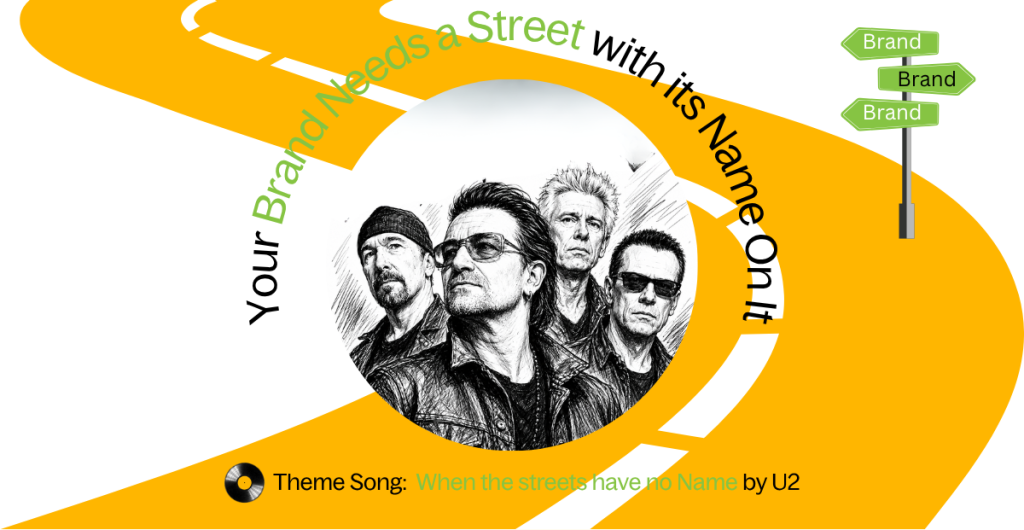
Theme Song: When the Streets Have No Name by U2
“Where the Streets Have No Name” was released by U2 in 1987. The song imagines escaping a world where streets, names and locations reveal who you are, where you belong and how people should judge you.
Beautiful idea for humans.
Terrible strategy for brands.
We picked this song for the RockingGEO playlist because it makes the idea impossible to miss. A street with no name sounds freeing in a song. For a brand, it means nobody knows where to find you, what you represent or why they should remember you.
Now the AI part becomes easy.
AI understands a brand through patterns. Every word, topic, association, source and repeated idea helps it decide where the brand belongs, what it represents and which questions it should answer.
Your brand needs a clear semantic destination: the position or area of expertise you want humans and AI to connect with your name.
Without it, you can publish everywhere, talk constantly and explain the company in ten different ways while creating nothing more than competing directions.
AI receives the signals.
They point towards several streets.
None of them has your name on it
- AI connects brands to topics through repeated words, meanings, sources, and contextual relationships.
- A semantic strategy defines the specific position and customer questions your brand wants to own.
- Consistency across your website, LinkedIn, YouTube, third-party sources, and other platforms strengthens AI understanding.
- Clear entity relationships help AI connect your brand with the right problems, solutions, audiences, and areas of expertise.
- Measure semantic progress through retrieval contexts, citations, associations, qualified visibility, and business impact.
Your brand already sends semantic signals
Every brand sends information into the systems that organize search and AI discovery:
The homepage explains the company.
Product pages describe the solution.
Blog articles discuss industry topics.
LinkedIn posts express opinions.
YouTube videos demonstrate expertise.
External articles, directories, reviews, mentions, and backlinks provide additional context.
Each source contributes another signal.
AI systems connect these signals to build a working understanding of the brand. They look for recurring relationships between the company, its products, its market, the problems it solves, the people it serves, and the sources that confirm its expertise.
A strong story helps people remember the brand. A strong semantic structure helps AI place the brand inside the right conversations.
That placement matters because discovery is changing.
A customer may begin with Google, ask ChatGPT to compare solutions, use Perplexity to research a category, read a LinkedIn post, watch a product video, and return to an AI assistant with a more specific question.
Each step relies on systems that retrieve, connect, summarize, and evaluate information.
Your brand needs a recognizable place within that information.
What a semantic strategy actually does
A semantic strategy defines the meaning your brand wants to build around itself and creates a plan for reinforcing that meaning. It answers practical questions:
- What should the brand be known for?
- Which customer problems should lead towards the brand?
- Which topics should sit closest to the brand?
- Which products, services, industries, and audiences should AI connect to it?
- Which sources can confirm those relationships?
- Which language should remain consistent across every platform?
The strategy creates a shared direction for content, SEO, GEO, brand messaging, digital authority, and cross-platform communication.
Consider a B2B software company that describes itself in five different ways:
- The homepage calls it a workflow platform.
- LinkedIn describes it as an AI productivity tool.
- The sales team calls it a project management solution.
- Blog content focuses on automation.
- External directories place it in an operations category.
Every description may be accurate. Together, they create several possible identities.
AI may struggle to determine which identity carries the most weight. The company may appear for broad questions while remaining absent from the high-value questions its buyers actually ask.
A semantic strategy chooses the primary direction and organizes the supporting ideas around it.
The company might decide that it wants to become strongly associated with “AI workflow automation for revenue operations teams.”
The surrounding semantic structure can then reinforce:
- AI workflow automation
- Revenue operations
- GTM processes
- Sales and marketing alignment
- Operational efficiency
- Workflow governance
- CRM automation
- Revenue technology
The brand now has a named street, connected roads, recognizable landmarks, and a destination.
How AI builds a map of your brand
Many modern AI systems represent language through numerical relationships. Words, sentences, documents, and topics can be converted into vectors that reflect how closely different concepts relate within a specific context.
You do not need to see those numbers to influence the result.
You need to understand the information that creates them.
Five types of signals shape the map.
1. Entity identity
An entity is a recognizable person, company, product, location, or concept.
Your brand needs a stable identity across the web. Its name, description, category, products, founders, audience, and expertise should form a consistent picture.
When the same company appears with unrelated descriptions across multiple sources, the entity becomes harder to place confidently.
2. Topic proximity
AI learns which topics frequently appear near your brand.
A cybersecurity company that consistently publishes about cloud access, identity management, permissions, and compliance builds proximity to those subjects.
Topic proximity grows through depth, repetition, context, and connections between related content.
Publishing one article creates a signal. Building a connected body of useful content creates a stronger pattern.
3. Problem-and-solution relationships
AI visibility depends on the connection between what people ask and what the brand can answer.
Your semantic strategy should connect the brand to:
- Customer problems
- Business goals
- Use cases
- Questions
- Comparisons
- Objections
- Buying criteria
- Desired outcomes
These relationships help AI understand when the brand becomes relevant.
4. Source reinforcement
Your own website provides one version of the story.
LinkedIn, YouTube, industry publications, partner websites, directories, interviews, mentions, reviews, and other third-party sources can reinforce that story.
Repeated meaning across credible sources increases clarity and authority.
The wording can change. The central meaning should remain recognizable.
5. Contextual consistency
Consistency comes from repeating a clear meaning across different contexts.
A product page may explain the capability.
A blog article may explore the problem.
A LinkedIn post may share an opinion.
A YouTube video may demonstrate the process.
A third-party article may confirm the expertise.
Each format performs a different job while supporting the same semantic direction.
A practical formula for semantic clarity
Semantic clarity can be represented through a simple working model:
Semantic clarity = relevance × consistency × authority × reinforcement
This is a strategic formula rather than a literal equation used by every AI platform.
Each part influences the strength of the overall result.
Relevance connects the brand to real audience questions and business problems.
Consistency keeps the central meaning recognizable across channels.
Authority gives the information credibility through expertise, evidence, and trusted sources.
Reinforcement repeats and expands the relationships over time.
Multiplication matters in this model.
A high volume of consistent content around irrelevant topics creates little business value.
Relevant content with weak authority may struggle to become a trusted source.
Authority without a clear semantic direction can support several disconnected identities.
The strongest strategy develops all four elements together.
How to build a semantic strategy for AI visibility
Step 1: Decide what answer you want back
Begin with the result.
Imagine a potential customer asking an AI assistant:
- Which companies solve this problem?
- What is the best approach for this situation?
- Which experts understand this topic?
- What should I consider before choosing a provider?
- Which solution fits a company like mine?
Define the questions where your brand should become a relevant part of the answer.
Then write the simplest possible statement connecting your brand to that space:
[Brand] helps [audience] solve [problem] through [solution or expertise].
This statement becomes the central direction of the semantic strategy.
Step 2: Map the language of your audience
Your internal language may differ from the language customers use.
Marketing teams often start with product terminology. Customers usually start with a problem, frustration, goal, comparison, or decision.
Map the complete language around the buying journey:
- Early problem awareness
- Symptoms and frustrations
- Category terminology
- Solution approaches
- Product capabilities
- Use cases
- Competitor comparisons
- Implementation questions
- Risk and trust questions
- Purchase criteria
This map connects the company’s expertise with the conversations already happening in search engines and AI platforms.
Step 3: Build a semantic cluster
A semantic cluster is a connected group of topics that supports one area of meaning.
Choose a central topic and organize the related subjects around it.
For example, a company offering AI governance software may build a cluster containing:
- AI governance
- AI risk management
- Model monitoring
- AI compliance
- Responsible AI
- Data privacy
- Internal AI policies
- AI vendor assessment
- Generative AI security
- Regulatory readiness
Each topic should have a clear relationship with the company’s product, audience, and expertise.
The cluster creates depth. Internal links, consistent terminology, structured pages, and complementary formats help search and AI systems understand the relationships.
Step 4: Align every platform
AI learns about your brand from more than one place.
Review the way the brand appears across:
- Website pages
- Blog content
- LinkedIn company pages
- Founder and employee profiles
- YouTube channels
- Podcast appearances
- Industry directories
- Partner websites
- Press coverage
- Guest articles
- Review platforms
Look for changes in category language, product descriptions, audience definitions, and value propositions.
The goal is semantic consistency rather than identical copy.
Every platform should express the same central meaning in the language and format that suits the channel.
Step 5: Strengthen external authority
A brand’s own content establishes its position. External signals help confirm it.
Identify the sources that already shape the conversation in your market:
- Industry publications
- Professional communities
- Research websites
- Comparison platforms
- Relevant directories
- Partner ecosystems
- Experts and creators
- Conferences and podcasts
- Customer websites
Build meaningful connections between those sources and the topics your brand wants to own.
A backlink carries technical value. A relevant mention also carries semantic context. The surrounding words, the source’s authority, and the relationship between the source and your category all influence the signal.
Step 6: Measure whether the direction is becoming clearer
Prompt tracking can provide useful observations. It represents one part of a wider measurement system.
Track signals such as:
- The questions and contexts where the brand appears
- The topics AI associates with the brand
- The sources AI cites when discussing the category
- The competitors appearing in the same answers
- The pages receiving traffic from AI platforms
- The quality and relevance of AI-referred sessions
- The growth of branded and category-related searches
- The leads, conversations, and revenue influenced by AI visibility
The goal is qualified visibility.
Your brand should appear in conversations that match its audience, expertise, offer, and business goals.
More content can create more streets
Content volume increases the number of signals surrounding a brand.
Direction determines what those signals build.
A company may publish hundreds of articles and still leave AI with an unclear understanding of its position. This happens when topics follow temporary opportunities, different teams use different descriptions, and each platform tells a separate version of the story.
The result resembles a city built without a map.
There are roads everywhere. Some connect. Some stop suddenly. Several have similar names. The destination remains difficult to find.
A semantic strategy gives every content decision a role.
One article defines the problem.
Another explains the category.
A product page connects the capability to the use case.
A customer story provides evidence.
A LinkedIn post strengthens the opinion.
A video demonstrates the expertise.
An external mention confirms the association.
Each asset becomes part of the same route.
Semantic strategy connects SEO, GEO, content, and brand
SEO creates the technical and content foundations that help information become discoverable.
GEO focuses on the way generative systems understand, retrieve, cite, and recommend that information.
Content strategy determines which ideas the brand should develop and how they support the customer journey.
Brand strategy creates a recognizable identity and position.
Digital authority strengthens trust through relevant external signals.
Semantic strategy connects these disciplines through one shared meaning.
At RockingGEO, visibility means helping humans and AI understand, trust, and share a brand’s story. Our work connects audience research, market analysis, SEO, GEO, content structure, brand consistency, and authority around a clear business direction.
The process begins with the question many teams skip:
What should this brand mean inside the conversations that matter?
The answer guides the topics, language, sources, formats, platforms, and relationships that follow.
🎵 Our Last Note: Give the street a name
AI does not need your brand to sound identical everywhere.
It needs enough consistent information to recognize the same meaning everywhere.
Choose the position.
Define the audience.
Map the questions.
Connect the topics.
Align the platforms.
Strengthen the sources.
Repeat the meaning with depth and relevance.
You do not need to see the mathematical formula behind every AI answer.
You need to understand what information you are putting into the system, how consistently you are supporting it, and what answer you want to receive back.
That is how a collection of signals becomes a recognizable direction.
That is how the street gets its name.