

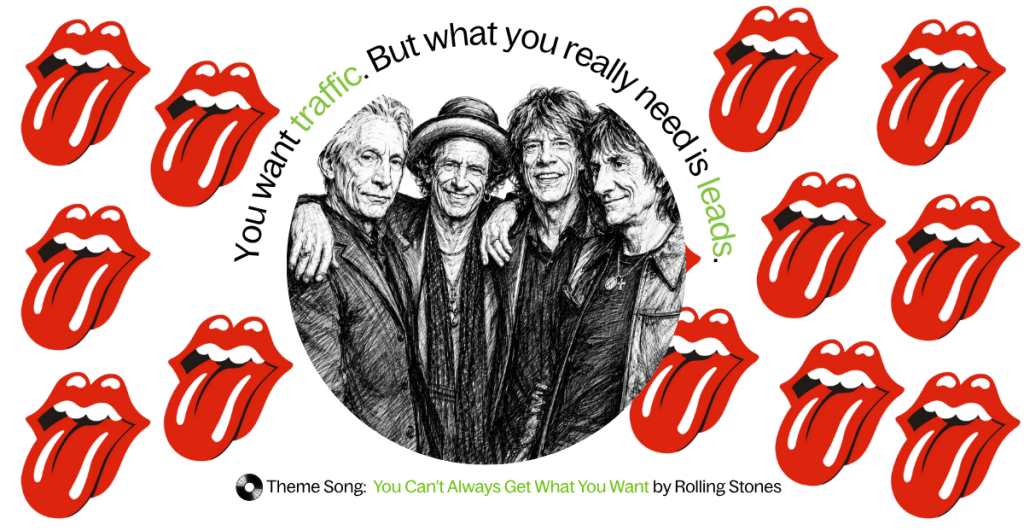
Theme Song: You can't Always Get What You Want by The Rolling Stones
“You Can’t Always Get What You Want” was released by The Rolling Stones in 1969. It is about desire, disappointment and the uncomfortable truth that getting what you want is not always the same as getting what you need.
Marketing teams should probably listen more carefully.
That is why this song made the RockingGEO playlist.
You want traffic. But what you really need is leads.
Your traffic dropped.
Before everyone panics, opens another dashboard and starts chasing prompts, answer one question:
Did your qualified leads drop?
For years, marketing teams lived from volume.
More impressions. More clicks. More sessions.
A bigger number made the strategy look healthy, even when most of those visitors were never going to buy.
AI is removing part of that traffic by answering basic questions, explaining the category, comparing options and helping people understand what they need before they reach your website.
So stop mourning every lost visit. Start measuring whether the people who arrive are the people your business can actually convert.
- Traffic can decline while qualified leads remain stable or grow.
- AI completes part of the research journey before the website visit.
- Low-intent clicks once made marketing reports look healthier than the business really was.
- Lead volume, lead quality, and conversion rate reveal whether demand actually changed.
- AI visibility should bring the brand into conversations that can influence a buying decision.
- Bottom line, just like the song “you can’t always get what you want” by the Rolling Stones – brands want traffic, but what they really need are leads
You Were Measuring Noise and Calling It Growth
For years, marketing teams treated traffic like proof that the strategy was working.
More impressions.
More clicks.
More sessions.
A bigger number appeared on the dashboard, and everyone felt productive.
The problem is simple: most of those visitors were never going to buy.
They came for a definition, a statistic, a quick answer, or a broad question with almost no commercial intent. They increased the traffic graph and contributed very little to the business.
The old search journey needed that volume because every stage of research created another click.
People opened five tabs, read three articles, compared several definitions, and visited a website long before they were ready to speak to anyone.
Marketing learned to live from that noise.
The formula looked reassuring:
More visibility → more traffic → more leads → more revenue
Every arrow leaked.
AI now completes part of that research before the website visit. It explains the category, compares the options, and helps buyers understand what they need before they arrive.
That means fewer meaningless clicks may reach your analytics.
Stop treating every missing session like lost demand.
Check whether the people who could actually become customers disappeared.
AI Is Filtering Before the Click
The research journey still exists.
It simply happens somewhere else.
A buyer can ask an AI assistant to:
- Explain the problem
- Define the category
- Compare possible approaches
- Identify suitable providers
- Build a shortlist
- Prepare questions for a sales conversation
In the old journey, each step could generate another search and another website visit.
Now several of those steps can happen inside one conversation.
Your analytics sees fewer sessions.
The buyer may still be moving towards a decision.
By the time that person reaches your website, they may already understand the problem, know the category, and have a clear reason to evaluate your company.
That visit carries more weight than someone looking for a quick definition.
Stop giving both visits the same value.
One creates a number.
The other can create a lead.
Fewer Visits Do Not Mean Fewer Buyers
A traffic decline creates an uncomfortable visual.
The line goes down.
The meeting appears.
Everyone asks what went wrong.
Sometimes the answer is: nothing.
Imagine a website receives 100,000 monthly visits and converts 1% into leads.
100,000 visits × 1% conversion rate = 1,000 leads
Later, AI handles more early-stage research. Traffic falls to 70,000 visits, while the people who arrive show stronger intent. The conversion rate rises to 1.5%.
70,000 visits × 1.5% conversion rate = 1,050 leads
Traffic fell by 30%.
Lead volume increased by 5%.
The website lost 30,000 visits.
The business gained 50 leads.
These numbers are illustrative. The point is very real:
Traffic and qualified demand can move in different directions.
A smaller traffic graph can still support a healthier business result.
Did Your Qualified Leads Drop?
This should be the first question in every conversation about falling traffic.
Look at:
- Qualified lead volume
- Lead-to-opportunity conversion
- Lead quality
- Demo or consultation requests
- Conversion rate on commercial pages
- Sales-accepted leads
These numbers tell you whether demand changed.
Traffic gives you context.
Leads give you the answer.
A company can lose thousands of low-intent visits while keeping the same number of serious buyers.
A company can also gain thousands of visits while producing fewer qualified leads.
Guess which dashboard usually gets celebrated.
Marketing teams love large numbers because large numbers look impressive.
The sales team cannot close a session.
The business cannot invoice a page view.
A lead has to be relevant, qualified, and capable of moving forward.
That is the number worth protecting.
The Traffic Number Is Useless Without the Conversion Number
Traffic volume has meaning only when you know what happens next.
A visitor reading a broad educational article carries different intent from a buyer reviewing a service page.
A person collecting statistics carries different value from someone comparing providers.
A ten-second visit and a qualified form submission should never sit inside the same conversation as equal outcomes.
Start separating the traffic:
- Informational traffic
- Commercial traffic
- Product or service traffic
- Comparison traffic
- Branded traffic
- Returning visitors
- Converting visitors
Now the decline becomes easier to understand.
A drop across broad informational articles may show that AI answered basic questions earlier.
A drop across product, service, and comparison pages may signal a real problem.
The total traffic number hides that difference.
Conversion data exposes it.
What Healthy AI-Driven Traffic Actually Looks Like
Healthy AI filtering may look like this:
- Overall traffic decreases
- Commercial traffic remains stable
- Conversion rates improve
- Qualified leads remain stable or grow
- Low-quality inquiries decrease
- Buyers arrive with stronger knowledge of the offer
That is a more efficient journey.
The website receives fewer people who need basic education and more people who have a reason to evaluate the brand.
A real visibility problem looks different: - Commercial traffic declines
- Qualified leads fall
- Conversion rates weaken
- Competitors appear more often in relevant AI answers
- Fewer suitable buyers reach the website
That situation needs attention.
The lesson is painfully simple:
Check the leads before declaring the traffic drop a disaster.
Visibility That Does Not Produce Qualified Demand Is Decoration
Prompt tracking can show where your brand appears.
Citation tracking can show which sources AI uses.
AI referral data can show which platforms send traffic.
Useful information.
Still incomplete.
Appearing in hundreds of irrelevant prompts gives the team something to screenshot.
Appearing in the right conversations gives the business a chance to grow.
The useful questions are the ones buyers ask while moving towards a decision:
- Which provider fits this type of company?
- Which solution works for this problem?
- What should I compare before choosing?
- Which companies have experience in this market?
- What is the best approach for this use case?
AI visibility should place your brand inside those conversations with a clear and accurate reason to consider it.
Visibility without relevance creates noise.
Visibility connected to qualified demand creates value.
Where RockingGEO Comes In
At RockingGEO, visibility means reaching the right people inside the conversations that can influence a decision.
We look at how AI understands the market, which competitors it recommends, which sources shape the answer, and which questions carry real commercial intent.
Then we connect that understanding to:
- Semantic content strategy
- SEO and GEO
- Website and content audits
- Brand consistency
- Online authority
- Qualified demand
The goal is clear:
Help AI understand where the brand belongs, help buyers understand why it matters, and help the business attract people it can actually convert.
A traffic graph shows activity.
Qualified leads show whether the strategy is doing its job.
🎵 Our Last Note: You Get What You Need
You may want the traffic graph to keep climbing forever.
It looks good in reports.
It gives everyone a large number to point at.
Your business needs something more useful.
It needs relevant people who understand the offer, trust the brand, and have a reason to take the next step.
AI may remove some of the low-intent clicks that inflated the old journey.
Good.
Measure who still arrives.
Measure who converts.
Measure whether qualified leads changed.
Then decide whether you have a problem.
You can’t always get the traffic volume you want.
You can get more of the qualified demand your business needs.
about the author

I’m Sarah Lahav – an AI thinker and business strategist at RockingGEO, where I help companies build brands that AI understands and people remember.
As a former tech CEO and co-founder, I’ve spent years connecting business strategy, customer relationships, product development, sales, and marketing. Today, I’m fascinated by the intersection of human thinking and artificial intelligence, exploring how people make better decisions and how businesses can use AI to solve real challenges.
I believe AI is at its best when it amplifies human curiosity rather than replaces it. I love asking better questions, challenging assumptions, and helping businesses turn AI into a practical partner instead of just another buzzword.