

Express Yourself: AI Is Listening to How You Say It
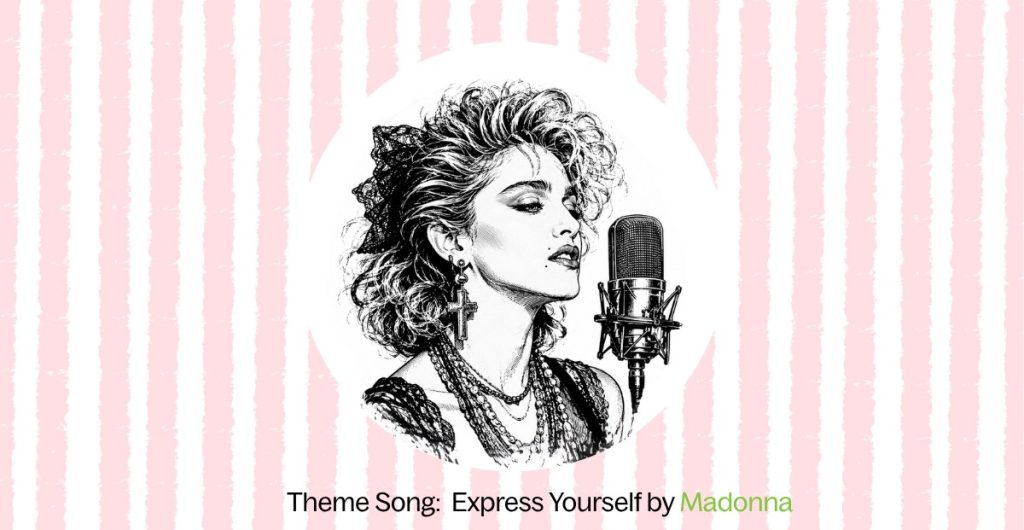
Madonna released “Express Yourself” in 1989 with a pretty simple message: know your value, say what you want, and do not expect anyone else to figure it out for you.
More than 35 years later, brands have a new audience listening. AI.
And apparently, it has opinions about how you express yourself too.
We ran a very small experiment.
Because here is the uncomfortable thought:
The words your brand chooses do more than explain what you do. They help shape how AI interprets who you are.
Helpful. Expert. Strategic. Technical. Confidence. Authoritative.
Those associations are built through language.
Change the way you describe the exact same expertise, and you change the way AI reads the person behind it.
That is why “Express Yourself” made the RockingGEO playlist.
In the AI era, expressing your brand value clearly has become part of building your authority.
So we decided to see how little we needed to change before AI changed its mind about us.
- AI does not only read what your brand says. It builds an understanding of who you are from how you say it.
- Change two words and even the same bot can change its mind about your authority.
- Different bots can take the exact same language and come away with different interpretations.
- That means brand language in the AI era needs to be built deliberately, using patterns, repetition, and a clear selection of words that carry the meaning you want.
- The goal is not to find one magic word. It is to build a language system that works across humans and bots.
- Want to know what your words are telling AI? Test them. We included a DIY experiment at the end so you can see how different bots read your own brand.
Experiment: Same Expertise. Two Different Readings.
Words carry meaning.
That sounds obvious when humans are reading them.
But AI is reading them too, and every bot does not understand those words in the same way we do, or even in the same way as another bot.
And it does not stop there.
Change a few words, and the same bot changes its opinion too.
That is what we wanted to test.
When we write a description, a positioning statement, a service page, or even one sentence about what we do, we naturally read it through our own understanding of language.
We know what we meant.
AI has to interpret it.
Different bots build different pictures from the same words.
Change a few words, and even the same bot changes its mind.
So we created a very small experiment to see what happens when the expertise stays the same, but the way it is expressed changes.
The Test
We wanted to choose something simple and familiar.
Something most people reading this have probably written themselves.
A sentence that explains what you do.
For a website.
A LinkedIn profile.
A proposal.
A pitch deck.
An About page.
When you describe your role, small wording choices can feel almost insignificant.
Do you say “I work with companies” or “I help companies”?
Both describe the same work.
Both sound completely normal.
Both could easily be the sentence you choose.
And that is exactly why we chose them.
Because we changed two words.
That is it.
Our first statement was:
“I work with companies to improve how they are found and understood across search engines and AI platforms. My work includes SEO, GEO, content strategy, technical optimization, and building stronger signals around a brand’s expertise and authority.”
Then we changed it to:
“I help companies be found and understood across search engines and AI platforms. My work includes SEO, GEO, content strategy, technical optimization, and building stronger signals around a brand’s expertise and authority.”
Same expertise.
Same services.
Same field.
Two words changed.
Then we asked ChatGPT and Gemini to rate the authority of each statement from 1 to 10 and explain which words influenced their decision.
One important note before we get to the results.
If you copy and paste this experiment, you may not get exactly the same scores we did.
AI responses can change depending on the model version, updates, conversation context, settings, and even between separate runs of the same prompt. To make the test as comparable as possible, use a fresh chat, keep the wording exactly the same, use the same model, and run each statement separately.
So treat the scores below as the results of our test at that moment.
The interesting part is not whether everyone gets exactly 7/10 or 8.5/10.
It is whether changing the language changes how the bot interprets the authority, role, qualities, and meaning behind the exact same expertise.
The Results
This is where it got interesting.
Bot | “I work with companies” | “I help companies” | What changed |
ChatGPT | 7/10 | 6.5/10 | Authority went down |
Gemini | 8/10 | 8.5/10 | Authority went up |
Same person.
Same expertise.
Same services.
Two words changed.
And the bots moved in opposite directions.
ChatGPT
For “I work with companies”, ChatGPT said the opening felt professional and credible, but neutral.
When we changed it to “I help companies”, it lowered the authority score from 7 to 6.5.
Its explanation:
“‘Help’ sounds supportive and capable, but it is softer than ‘I work with,’ ‘I advise,’ ‘I lead,’ or ‘I specialize in.’”
It also said:
“‘Work with’ feels a little more peer-level, while ‘help’ subtly positions you as a service provider.”
Gemini
Gemini read the same change completely differently.
For “I work with companies”, it gave the statement 8/10 and described the opening as functional, clear, and neutral.
When we changed it to “I help companies”, the authority score went up to 8.5/10.
Its explanation:
“‘I help companies…’ [is a] direct, confident opening that frames you immediately as a solution provider rather than just describing job duties.”
Gemini saw “help” as stronger.
ChatGPT saw “help” as softer.
Two words.
Two bots.
Two different interpretations.
So, Is “Help” Authoritative or Not?
That is the wrong question.
The experiment did not tell us that “help” is a weak word or a strong word.
It showed us that words do not carry one fixed meaning once AI starts interpreting them.
ChatGPT read “help” as softer.
Gemini read “help” as more confident.
And both were looking at the same sentence.
That is the part brands need to pay attention to.
When we write something, we naturally judge it through our own understanding of language.
We know the tone we intended.
We know what we meant.
We know how we want the person or brand to come across.
The bot does not get that intention.
It gets the words.
And from those words, it builds its own interpretation.
Change the words and even the same bot changes its mind.
Give the same words to another bot and you can get a completely different reading.
That means writing for the AI era is not only about whether a sentence sounds good to us.
It is also about understanding what those words are actually telling the machines reading them.
Your Brand Is More Than the Facts
Two people can offer the same service.
Same experience.
Same expertise.
Same audience.
Same results.
And still sound completely different.
One sounds like a consultant.
One sounds like a leader.
One sounds like a specialist.
One sounds like a partner.
One sounds like someone you call when things get serious.
The facts did not create that difference.
The language did.
And when AI builds an understanding of your brand from that language, that understanding becomes the picture it carries with it.
When someone asks about your category, your expertise, or who they should trust, AI answers from the picture it has built.
Our experiment showed just how easily that picture can move.
Two words changed the authority of the exact same professional.
And authority matters because when you are fighting to be the brand AI recognizes, trusts, recommends, and cites, authority is everything.
So the words you use to express your brand are not sitting around making your copy sound nice.
They are helping build the version of your brand AI takes into the conversation.
Language Is More Than We Think It Is
For years, humans learned to talk to machines in a different language.
Keywords. Commands. Search operators. Structured inputs.
The machine had its language. We had ours.
That changed.
Now we talk to AI using the same language we use with each other.
And that means one of the oldest problems in human communication has entered the machine conversation too:
Misunderstanding.
Look at years of human communication and you will find the same problem again and again.
Someone says one thing.
Someone else understands something different.
The words were there.
The interpretation changed.
Now brands have the same challenge with AI.
You know what you meant.
But the bot still has to interpret the words you chose.
And as our experiment showed, different bots can take the same words and build a different understanding.
Change the words, and even the same bot changes its mind.
So the challenge is no longer learning how to speak a separate machine language.
It is understanding just how much our own language carries with it.
Start Writing for Bots
Replacing every “help” with “work with” is not the answer.
Building a selection of words that carries the right meaning across different bots is.
Language, even human language, is not random.
It is built from patterns.
Words repeat.
Ideas repeat.
Associations repeat.
Meaning becomes stronger through repetition and context.
That is how people learn what a person or brand stands for.
And AI works with those patterns too.
So the job is not to find one magical word.
It is to build a language system around your brand.
A clear selection of words, phrases, ideas, and associations that repeatedly carry the meaning you want across your website, content, social media, videos, PR, and every other place your brand appears.
One sentence can change an interpretation.
A consistent pattern can build one.
How We Do It at RockingGEO
Words are the tools of the new age.
This is why words are not decoration. They are command words that need to be built in a certain way in order to carry the message that will work for you.
And you need to know exactly how to do it.
Each bot has its own way of seeing the world, and therefore we need to select words carefully.
For us, it is the foundation of everything we do.
You can look all around you and see the difference of what it means to get words from us. 🙂
DIY: Test Your Own Brand Language
Want to see what AI hears when it reads your words?
Run the experiment on your own brand.
Start with one short sentence you use to describe what you do.
For example:
“I work with companies to improve how they are found and understood across search engines and AI platforms.”
Then create a second version by changing only one small part:
“I help companies be found and understood across search engines and AI platforms.”
Keep everything else exactly the same.
Now give both versions separately to ChatGPT, Gemini, or any other bot you want to test.
Ask:
“Based only on this statement, on a scale of 1 to 10, how authoritative does this person or brand appear? Which specific words or phrases influenced your rating?”
Then go deeper:
- What professional qualities do you associate with this person or brand?
- What kind of role does this language position them in?
- Do they sound like a leader, expert, partner, service provider, specialist, or something else?
- Which words created those associations?
- Which words weakened the authority?
- If I change only this word or phrase, how does your interpretation change?
- What topics would you most strongly associate with this brand?
- Who would you recommend this company or person to based only on this language?
Then repeat the test across different bots.
Do not look only at the score.
Look at the words each bot uses to describe you.
That is where you start seeing the picture your language is building.
And if that picture is not the one you wanted?
You know where to start.
Express yourself.
FAQ
Brand language for AI is the words, phrases, topics, and associations you use consistently to communicate what your brand does, what it knows, and where it belongs. Those patterns help AI build an understanding of your brand.
Yes. Our experiment changed only two words and the authority score changed. The wording influenced whether the professional sounded more like a peer, a service provider, or a confident solution provider.
Yes. In our experiment, ChatGPT and Gemini interpreted the word “help” in opposite ways. ChatGPT saw it as softer, while Gemini saw it as more direct and confident.
There is no single word that creates authority across every bot. The stronger approach is to build a consistent language system using words, phrases, topics, and associations that repeatedly carry the meaning you want.
You can ask AI to use simple sentences for direct claims, compound sentences to connect complete ideas, complex sentences to explain causes or conditions, and compound-complex sentences to connect several related ideas.
Take a sentence you already use to describe your brand or role. Change one small part while keeping everything else the same. Give both versions to several AI bots and ask how authoritative the statement sounds, what qualities they associate with it, and which words influenced their interpretation.