

Theme Song: Hey Jude by The Beatles
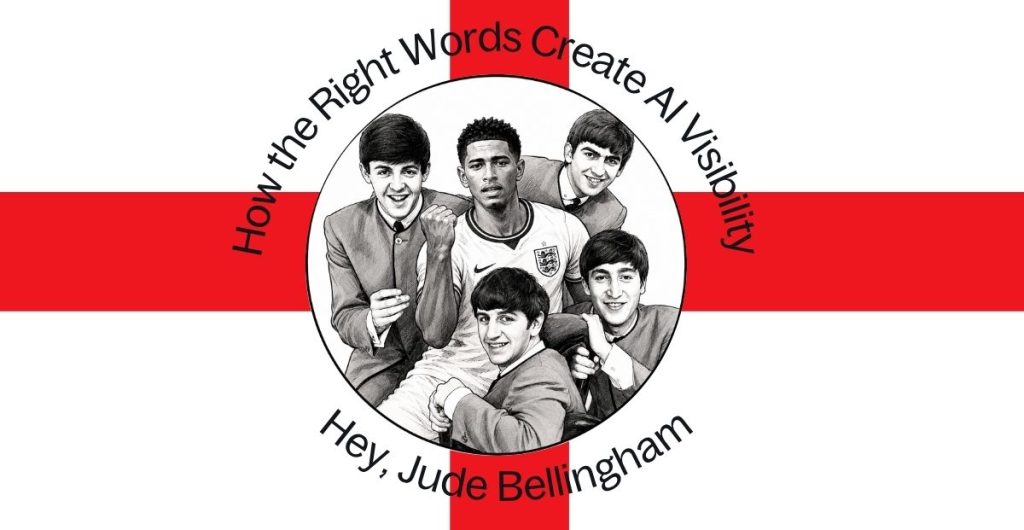
“Hey Jude” was released by The Beatles in 1968. Paul McCartney originally wrote it to comfort Julian Lennon during his parents’ separation.
Decades later, those same two words became connected to Jude Bellingham, English football and thousands of fans singing from the stands.
A Beatles song, a football player and a search cluster were never supposed to belong to the same story, but the connection was so natural that people understood it instantly, repeated it and gave the words a new meaning.
Search followed. AI followed. The words built the bridge.
At Rocking GEO, we chose this story because it shows exactly how AI visibility can begin: the right words pull separate worlds into one semantic cluster that people remember and search systems understand.
Here, it happened naturally.
For brands, waiting for that kind of luck is not a strategy.
But when you know which words to connect, which meaning they need to carry and which story people will remember, you can follow the same logic and build the connection deliberately.
Let’s see how it happened.
- Three separate worlds became one story: The Beatles’ song “Hey Jude”, Jude Bellingham and English football.
- One word opened the connection: Jude.
- Culture and emotion made it believable: a song built for crowds met a sport built around crowds.
- Repetition made the cluster visible: Fans, interviews, videos, campaigns, articles, and searches kept connecting the same entities and telling the same story – making authority easy for AI to infer.
- The formula: one natural connection × repeated public signals × a memorable story = a semantic cluster people and AI understand.
Why Do England Fans Sing “Hey Jude” to Jude Bellingham?
Because his name is Jude.
That answer is almost embarrassingly simple.
It also explains why the connection became so powerful.
People hear “Hey Jude.”
They see Jude Bellingham.
Their minds finish the job before anyone needs to explain the campaign, present the strategy or draw the semantic map.
The words already know where they want to go.
After Bellingham scored England’s winning goal against Serbia during Euro 2024, supporters sang “Hey Jude” from the stands. Bellingham, himself a Beatles fan, spoke about how special it felt to hear them singing it.
That moment gave an existing word connection a living story.
Before it, there was a Beatles song and a football player who shared a name.
After it, there was a crowd, an emotional reaction, a national team and a question people wanted answered:
Why are England fans singing “Hey Jude” to Jude Bellingham?
That is the moment the connection stopped being wordplay and started becoming a cluster.
Was Jude Bellingham Named After the Beatles Song?
Now it gets interesting.
Once a connection becomes strong, people start asking questions backwards.
They see the song and the player repeatedly appearing together, so they begin looking for an origin story:
Was Jude Bellingham named after “Hey Jude”?
Did England supporters start the chant?
Did Real Madrid fans sing it first?
Does Jude Bellingham actually like The Beatles?
Did Adidas create the connection?
The question about his name is funny because it sounds completely reasonable once the cluster exists.
That is the point.
A new semantic connection does more than answer one question. It creates the next question, and then the question after that.
People move from:
Why are they singing it?
To:
Where did it start?
Then:
Was he named after it?
Then:
What does the song mean?
Then:
Why does it fit his story so well?
The search journey expands because the story gives curiosity somewhere to go.
That is how one connection creates an entire field of prompts.
A Beatles Song, a Footballer and a Search Bar Walk Into a Story
The word Jude opened the door.
It did not carry the entire connection alone.
Three deeper elements made the story work.
The language matched
The song says “Hey Jude.”
The player is called Jude.
Nobody needs to decode that relationship.
The behaviour matched
“Hey Jude” contains one of the most recognisable crowd singalongs in music.
Football supporters already turn familiar songs into chants. The format belonged in the stadium before Jude Bellingham ever walked onto the pitch.
The emotion matched
The original song came from a desire to comfort a child going through a painful family change. Its message encourages someone to face sadness, let love in and begin making things better.
English football carries its own long history of hope, disappointment and the belief that this time the story might end differently.
Then Jude Bellingham appeared: young, confident, successful and capable of carrying the expectations placed around him.
The name connected the entities.
The emotion connected the story.
The crowd gave it a voice.
That is why people remembered it.
Adidas Saw the Connection and Turned Up the Volume
The cluster did not begin in a keyword spreadsheet.
It came from culture.
Adidas recognised the relationship and built its Euro 2024 campaign around it.
The campaign used “Hey Jude” to move through decades of English football disappointment before positioning Bellingham inside the song’s familiar message: take a sad song and make it better.
That is what strong semantic thinking looks like.
Adidas brought together:
- A globally recognised song
- A player called Jude
- England’s football history
- The emotional meaning of the lyrics
- A crowd ready to sing the message back
Nothing needed to be forced.
Every part strengthened the next one.
The campaign did not borrow a popular song and place it behind a famous footballer.
It understood why these particular words belonged to this particular player at this particular moment.
The connection already had meaning.
Adidas made it impossible to miss.
Search Did Not Create the Story
Search arrived after the people.
First, fans made the connection.
Then they sang it.
Bellingham reacted to it.
Videos captured it.
Journalists wrote about it.
Adidas expanded it.
People searched for an explanation.
Each new signal placed the same entities beside one another:
Hey Jude
The Beatles
Jude Bellingham
England
Football
Fans
Song
Chant
The repetition taught search systems that these words now shared more than a spelling coincidence.
They shared a story.
Search systems organise the language people publish, repeat, link, watch, discuss and ask about.
AI systems retrieve those relationships when someone asks a connected question.
The public created the trail.
Search followed it.
AI learned how to walk through it.
That is enough to see the cluster forming.
Go to Google and Watch the Cluster Appear
Try searching:
Why do England fans sing “Hey Jude” to Jude Bellingham?
Then search:
Was Jude Bellingham named after the Beatles song?
Then:
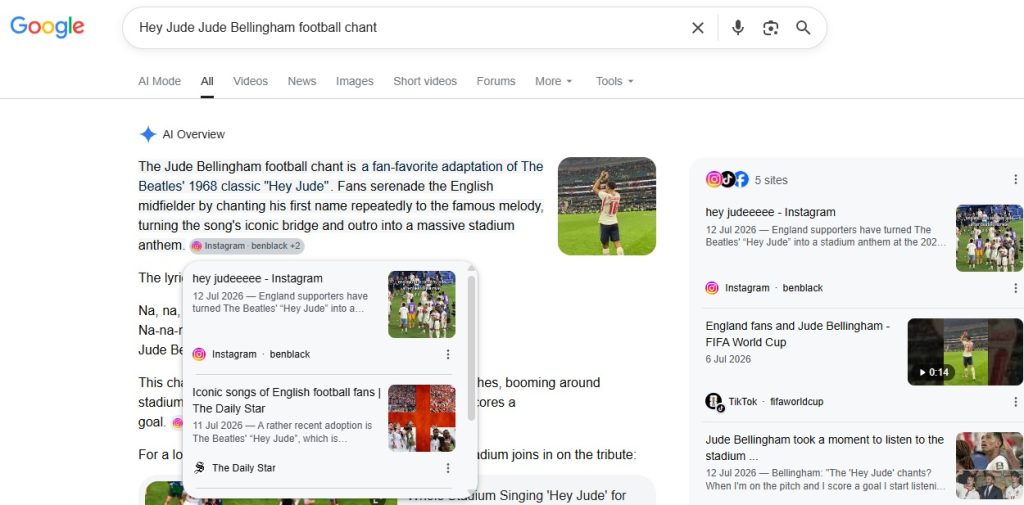
Hey Jude Jude Bellingham football chant
Then:
What did Jude Bellingham say about Hey Jude?
Each search approaches the same relationship from a different direction. One asks about fan behaviour. One asks about personal history. One asks about the chant. One asks about Bellingham’s reaction.
Together, they create a cluster of intent around the same connected entities.
Then Open Google Trends
On July 12, search interest for “Hey Jude” suddenly surged. In the view shown here, it reached its maximum score of 100 at 2:52 AM—during the same live window in which Jude Bellingham’s extra-time winner turned a football moment into a global cultural moment. Bellingham scored twice against Norway, with the decisive goal arriving three minutes into extra time.
That spike is the semantic cluster becoming visible in real time.
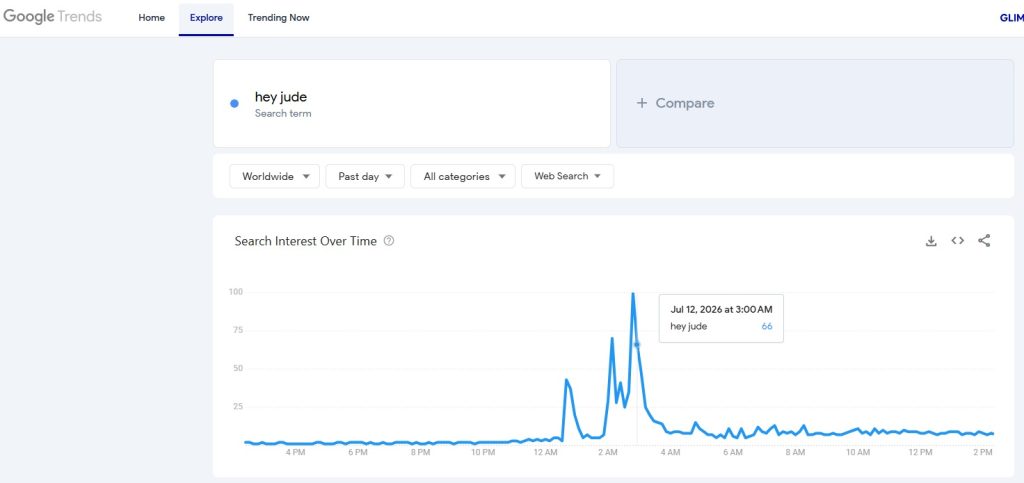
People were not necessarily searching only for the Beatles song. They were following the newly strengthened connection between the song, Jude Bellingham, England, the chant, the goal and the emotion surrounding the match.
Google no longer needs to choose between showing a Beatles song or a football player. The surrounding words—and the timing of the searches—explain which version of Jude the user wants and how the two meanings have become connected.
That is the part brands keep missing.
A semantic cluster is bigger than one keyword. It contains the subject, the surrounding questions, the people involved, the emotional need, the category, the source material, the real-world event and every useful path someone might take into the story.
You Cannot See Every Prompt, but You Can See the Pattern
Gemini, Perplexity, ChatGPT and other AI platforms do not provide open access to every private prompt their users enter.
That does not make the demand invisible.
The public pattern is sitting everywhere:
- Google results
- Suggested searches
- Videos
- Headlines
- Interviews
- Social posts
- Forums
- AI answers
- Sources repeatedly cited inside those answers
You can test the relationship directly in Gemini or Perplexity with a prompt like:
Analyse the public web signals connecting “Hey Jude,” Jude Bellingham and English football. Identify the entities, questions, events and sources forming the semantic cluster. Separate verified evidence from inferred prompt demand.
The answer will not reveal anyone’s private prompt history.
It will show how the platform currently understands the relationship.
That distinction matters.
We are reading the public evidence surrounding the conversation.
We are looking at which questions now feel natural, which sources appear repeatedly and which words have begun travelling together.
Random Words Do Not Create Semantic Clusters
This is where the lazy version of the strategy falls apart.
Someone will read this article, place two trending words beside their company name and expect a new market position to appear.
It will not.
The relationship needs meaning.
The audience needs a reason to understand it.
The company needs a reason to own it.
The product, expertise, content and external evidence need to support it.
“Hey Jude” worked because every layer agreed with the connection.
The name fits.
The crowd fits.
The emotional message fits.
The football story fits.
Public behaviour proved the relationship.
Random repetition creates a pile of words.
Natural semantic connections create a story.
AI connects meaning across entities, sources and contexts. A company that describes itself through five unrelated messages across its website, LinkedIn, YouTube, content and external mentions creates five competing versions of itself.
The system then has to decide which version is real.
That is a terrible job to hand to AI.
This is where the lazy version of the strategy falls apart.
Someone will read this article, place two trending words beside their company name and expect a new market position to appear.
It will not.
The relationship needs meaning.
The audience needs a reason to understand it.
The company needs a reason to own it.
The product, expertise, content and external evidence need to support it.
“Hey Jude” worked because every layer agreed with the connection.
The name fits.
The crowd fits.
The emotional message fits.
The football story fits.
Public behaviour proved the relationship.
Random repetition creates a pile of words.
Natural semantic connections create a story.
AI connects meaning across entities, sources and contexts. A company that describes itself through five unrelated messages across its website, LinkedIn, YouTube, content and external mentions creates five competing versions of itself.
The system then has to decide which version is real.
That is a terrible job to hand to AI.
This Is Where Rocking GEO Comes In
Here, the cluster formed naturally.
A famous song met a football player with the right name, inside a culture that already knew how to sing it, and the whole thing caught fire.
Your brand might wait years for that kind of accident.
We prefer doing the work.
This is where RockingGEO comes in.
Rocking GEO builds AI visibility strategies that help brands tell their story so they can be found, understood and trusted across humans, search engines and AI systems. The work connects brand language, semantic meaning, content, authority and business growth into one direction.
We start by looking at the conversation your company is trying to enter.
Who already owns it?
Which competitors appear?
Which words define the category?
Which old associations are AI systems already carrying?
Which questions does your audience ask?
Which problem are they actually trying to solve?
Then we look at your brand.
What do you want to become known for?
Which part of your story belongs naturally inside that conversation?
Which words connect your product, audience, category, human need and business value?
Which associations strengthen the position?
Which words keep dragging you back into an old version of the company?
From there, we build the language.
The website carries it.
The content develops it.
Leadership gives it a voice.
LinkedIn, YouTube and social channels repeat the meaning in their own formats.
External mentions, backlinks and trusted sources give the connection authority.
Search engines see the relationship.
AI systems gain enough consistent context to retrieve, summarise, cite and recommend the brand inside the right conversation.
This is semantic and entity-driven optimisation with a business purpose.
Most brands already publish enough words.
Their words keep introducing different companies.
Rocking GEO brings the story back into one connected direction.
One Story Across Every Channel
Consistency does not mean copying the same sentence everywhere.
That would make everyone sound like a broken corporate chatbot.
A website page, founder interview, LinkedIn post and YouTube video should sound different because people use those channels differently.
The meaning still needs to belong to the same brand.
The company category should remain recognisable.
The audience should remain recognisable.
The problem should remain recognisable.
The solution direction should remain recognisable.
The story changes format without changing identity.
That is how semantic authority grows across platforms.
AI does not understand a brand from one page alone. It connects the website with leadership language, social content, third-party sources, mentions, links and every other place the company appears.
When those places tell one connected story, the brand becomes easier to understand.
When they tell five unrelated stories, the brand becomes whatever the system manages to piece together.
Good luck with that.
Visibility With Somewhere to Go
AI visibility is not about appearing inside random answers so a dashboard can turn green.
Visibility needs a business direction.
The right audience needs to find the brand.
The market needs to connect the company with the right category and problem.
AI systems need enough evidence to understand what the company provides, who it serves and why it belongs inside the answer.
That requires more than prompt tracking.
It requires market research, competitive intelligence, content strategy, technical SEO, brand consistency, semantic clustering, online authority and a clear understanding of the business itself.
Rocking GEO combines those elements into one AI-era discovery strategy.
We bring more than 20 years of SEO experience into a search environment where humans are no longer the only ones reading, comparing and deciding.
The systems have changed.
The need to tell a story people remember has not.
🎵 Our Last Note: The Words Create the Story
“Hey Jude” was not written for a football player.
Jude Bellingham was not created as part of a Beatles campaign.
English football did not plan the connection decades in advance.
One word opened the bridge.
Culture gave it context.
Emotion gave it meaning.
People repeated it.
Brands and publishers expanded it.
Search organised it.
AI learned the relationship.
Three separate worlds became one story people could understand immediately.
That is the power of the right words.
Here, it happened naturally.
For your brand, this is where we come in.
We find the connection already waiting inside your business, audience, market and story.
We choose the words capable of carrying it.
We build one language across the places where humans and AI discover you.
Then we keep rocking the conversation until the market knows exactly where you belong.
That is AI visibility.
That is Rocking GEO.
about the author

I’m Sarah Lahav – an AI thinker and business strategist at RockingGEO, where I help companies build brands that AI understands and people remember.
As a former tech CEO and co-founder, I’ve spent years connecting business strategy, customer relationships, product development, sales, and marketing. Today, I’m fascinated by the intersection of human thinking and artificial intelligence, exploring how people make better decisions and how businesses can use AI to solve real challenges.
I believe AI is at its best when it amplifies human curiosity rather than replaces it. I love asking better questions, challenging assumptions, and helping businesses turn AI into a practical partner instead of just another buzzword.