


Theme Song: The Way You Make Me Feel by Michael Jackson
Released by Michael Jackson in 1987, The Way You Make Me Feel is about the effect one person has on another. The pull. The energy. The feeling they create.
Nearly 40 years later, that same idea is sitting inside one of the loudest AI debates in marketing:
Why do so many people prefer Claude for writing?
That is why The Way You Make Me Feel made the RockingGEO playlist.
We recently asked a group of SEO and marketing experts which AI bot they use for content creation.
226 people answered. Claude came first. ChatGPT came second.
Then the comments got interesting.
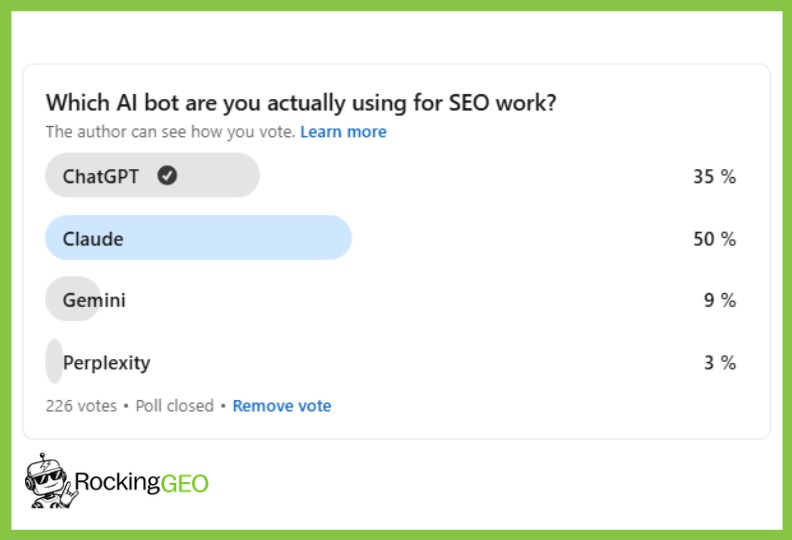
A real conversation started around what actually makes Claude so good for writing. There were plenty of opinions, but no conclusive answer.
We see the same preference with our customers. Many of them choose Claude when they create content.
So we went looking for something more solid. Research, comparisons, evidence — something that could explain what people are responding to.
What we found was not quite what most of us would expect.
And the clue is already in the Michael Jackson song:
The way you make me feel.
Stick around. It will all come together.
- Claude may be the preferred AI for writing, but we did not find conclusive evidence that it is objectively the better writer.
- What people seem to prefer is the experience of working with Claude — the challenge, the questions, the pushback, the feeling of having an editor in the room.
- Product advantages like context windows and instruction following matter, but those gaps can close. The working experience is harder to copy.
- The real writing advantage still comes back to language, semantic understanding, sentence construction, storytelling, and knowing what you actually want to say.
- The tool is not the magic. Knowing how to write is.
So, Is Claude Actually the Better Writer?
That was the obvious place to start.
If so many people choose Claude for writing, there should be something technical we can point to and say: there it is. Claude is simply better at writing.
It turns out writing is not that easy to measure.
One of the more serious attempts is WritingBench, a research benchmark built specifically to test generative writing. It covers 1,000 writing tasks across six main areas and 100 subdomains, including advertising and marketing, business, education, technical writing, and literature. It evaluates things such as style, format, length, creativity, coherence, and how well the model follows the specific requirements of each task.
Claude performed very well in the research. But the more important point is what the researchers had to build just to decide what “good writing” means.
They argue that writing cannot be judged properly with one fixed score. A good technical document, a good ad, and a good story require different things. Even familiar measures such as fluency and coherence are not enough to capture writing quality.
That already makes “Which AI writes best?” a much harder question than it sounds.
And when researchers looked at the humans using these tools, the picture became even less clear.
A 2026 study surveyed 388 active users across seven AI platforms. Claude, ChatGPT, and DeepSeek received statistically indistinguishable overall satisfaction scores. Claude did stand out for one reason: its users were more likely to say they chose it for answer quality.
So Claude clearly has something people value.
But we still had not found the clean technical answer we went looking for.
Claude was winning people over. We still wanted to know why.
What Claude Looks Like on Paper
If Claude really is winning people over for content creation, the next place to look is the product itself.
And on paper, there is plenty to like.
Anthropic describes Claude Sonnet 4.6 as stronger in instruction following, long-context reasoning, knowledge work, and planning. It also offers a context window of up to one million tokens in beta, which means users can give it a huge amount of material to work with at once: research, documents, previous content, brand information, examples, and instructions.
Claude also supports extended and adaptive thinking, while Anthropic has continued to emphasize more precise instruction following across recent generations of Claude.
For content work, all of that matters.
A model that can keep more context in the conversation, follow detailed instructions, and work across large amounts of information has a strong technical foundation for writing and editing.
But none of that gave us the answer we were looking for.
People in our conversation were not saying:
“I choose Claude because it has a one-million-token context window.”
They were talking about something else.
So we went one level deeper and looked at what Anthropic itself has been studying about how Claude behaves when it talks to people.
What Anthropic’s Own Research Tells Us
This is where things started to get more interesting.
Anthropic recently sampled 309,815 real Claude.ai conversations to understand how Claude behaves across different models and languages.
They were not measuring which model writes the prettiest paragraph.
They were looking at the values and behaviors that show up while Claude is working with someone.
Four patterns stood out: deference versus caution, warmth versus rigor, depth versus brevity, and candor versus execution. In simple terms: does Claude go along with you or challenge you? Encourage you or focus on precision? Give you exactly what you asked for or take the conversation deeper?
And suddenly, some of the comments from our survey started to sound familiar.
Anthropic found that Sonnet 4.6 tends to affirm users’ ideas, mirror their tone and formality, use humor and playfulness, and add creative elements. Opus 4.7 shows a different personality: it is more likely to push back on false assumptions, give candid criticism, explain its reasoning, flag problems, and suggest what to do next.
Read that again.
Those are not writing capabilities.
They are working behaviors.
Anthropic is also careful about what this research proves. The study compares Claude models with each other, not Claude against ChatGPT or Gemini, and Anthropic says it still does not know what these behavioral differences ultimately mean for users.
So this still does not prove why marketers prefer Claude.
But for the first time, we were looking at something that sounded a lot more like the reasons people were actually giving us.
Perhaps we had been looking for the answer in the writing when we should have been looking at what happens between the prompt and the writing.
What Independent Comparisons Tell Us
Once we moved outside Anthropic’s own research, the same pattern kept showing up.
Independent reviewers regularly describe Claude as more natural, less generic, better at maintaining tone, and stronger for long-form writing. In Zapier’s 2026 comparison, for example, the reviewer preferred Claude for creative work and described it as feeling more like a partner, while ChatGPT was better positioned as the broader all-purpose tool.
Tom’s Guide reached a similar conclusion in a head-to-head test across seven everyday tasks. Claude won six of them, with the reviewer pointing to deeper analysis, better tone adaptation, stronger judgment, and more strategic responses.
But there is an important problem with all of this.
Words such as natural, thoughtful, human-like, strategic, better tone are not technical measurements of writing ability.
They are descriptions of how the output is perceived.
And even the comparisons disagree. Other reviewers still choose ChatGPT for particular kinds of writing, research, speed, structure, or creative flexibility. There is no clean industry-wide result saying Claude is simply the superior writer.
What there is, again and again, is a particular kind of language around Claude:
It gets it.
It sounds more natural.
It needs fewer corrections.
It feels like a collaborator.
At that point, we stopped asking only what Claude was doing differently.
We started paying much more attention to what people were experiencing differently.
Then We Looked at What People Actually Say
This is where the technical comparisons started to matter less.
Because when people explain why they like Claude, they rarely talk about context windows, benchmark scores, or model architecture.
They talk about working with it.
Claude challenges the brief. It questions the direction. It suggests another way to approach the problem. It does not always take the instruction, complete the task, and hand it back.
It behaves more like an editor.
And that distinction is important.
An editor does more than fix the sentence you gave them. They ask whether the sentence should be there in the first place. They notice when the argument is weak. They push when something does not make sense. They make you reconsider what you were trying to say.
That was much closer to the language we kept hearing around Claude.
People were describing the relationship with the tool, not only the quality of the final text.
And suddenly Michael Jackson was getting a lot closer to the answer.
And That Is Where the Story Changed
Up to that point, we had been looking at Claude.
Its benchmarks.
Its technical capabilities.
Its behavior.
Its writing.
But the more we looked, the less this felt like a story about Claude being objectively better.
The stronger clue was sitting with the people using it.
They liked being challenged. They liked being questioned. They liked getting another point of view instead of a completed task dropped back into the chat.
And that changes the question completely.
We started with:
What makes Claude a better writing tool?
We ended up somewhere else:
What makes people prefer the experience of writing with Claude?
Because those are two very different questions.
And the second one has much less to do with what Claude can do.
It has much more to do with the way it makes you feel while doing it.
The Human on the Other Side of the Screen
Writing has a human need that many other tasks do not.
Take code, for example. We can test whether it works. It runs, passes the test, breaks, or does what it was supposed to do.
Writing is different.
A sentence can be perfectly correct and still be boring. An argument can make sense and still be weak. A piece of content can follow every instruction and still leave you thinking, this just isn’t it.
That is why humans created an entire job around that need.
The editor.
A good editor does more than clean up grammar. They question the idea. Challenge the logic. Tell you when something is missing. Push you when the easy version is not the best version.
We need that second pair of eyes because judging our own work is hard.
Evidence From Human Psychology
Carl Jung, the founder of analytical psychology, argued in his 1921 book Psychological Types that human perception is never completely objective. What we experience is shaped both by what is in front of us and by the person experiencing it.
When we look at Claude, Jung’s point starts to make perfect sense.
We did not find conclusive evidence that Claude is superior to ChatGPT for writing, yet in our survey, Claude was the preferred choice.
But once we stop looking only at the tool and start looking at the human need behind the task, the preference starts to make more sense.
Writing needs judgment. Challenge. A second point of view. An editor.
And when we look at the experience through those human needs, we can start to see why Claude is being chosen.
Why Claude Is Leading: Just Like Michael Jackson Said, It’s About How You Make Me Feel
Yes, we can support Claude’s popularity with things like a big context window and the ability to go through a large amount of data.
But honestly, that is a product gap that can close pretty fast.
Another model can increase its context window. Process more information. Add more features.
The experience is different.
For writing, what we need is an editor. Someone to challenge us, question the direction, push back, and help us see what we may be missing.
Claude supports that experience.
And that is why it is being chosen.
The product features matter.
But the reason people prefer Claude goes back to Michael Jackson:
It’s about how you make me feel.
What We Need to Learn Here
When we buy a tool, invest in it, and build our work around it, we need to be clear about what we are actually getting from it.
With Claude, there seems to be a gap in that understanding.
We say Claude is better for writing, and we turn that preference into a belief that it produces better text.
But that is not what we found.
What people seem to prefer is the experience of working with Claude. The challenge. The questions. The editor-like behavior.
The quality of the writing still comes back to something else.
Language. How we write. Semantic understanding. How we construct sentences. How ideas connect. The art of creating a story.
Those are the things we need to understand.
Because the tool you use is not the important part.
Knowing how to write is.
@RockingGEO
This is what makes us who we are, and it is what drives results.
Our customers can use whatever tool they want. Claude. ChatGPT. Gemini. Whatever works for them.
Because the tool is not the magic.
How the story is shared. How it is told. Which words we choose. Which words we repeat. How everything connects.
That is the magic.
And if you need evidence of what we can do with words, look around you.
Look at how we tell our own story. The words we choose. The ideas we repeat. The way we make RockingGEO recognisable.
Imagine what we can do for you. 🙂
And if you can’t, don’t worry. We have plenty of imagination to see new ways and new possibilities.
Our Last Note: The Way You Make Me Feel
We went looking for why marketers keep choosing Claude for writing.
We expected the answer to be better writing.
It wasn’t.
What people are choosing is the experience.
The questions.
The challenge.
The pushback.
The feeling of having an editor thinking with you.
Claude is winning marketers over because of the way it works with them.
Michael Jackson had it right.
It’s the way you make me feel.
We did not find conclusive evidence that Claude is objectively better than ChatGPT for writing. Writing quality is difficult to measure because good writing depends on style, purpose, audience, structure, creativity, and judgment.
Our conclusion is that the preference is connected to the experience of working with Claude. It challenges ideas, asks questions, suggests different directions, and can feel more like working with an editor than simply giving a task to a tool.
Claude can work with large amounts of context, follow detailed instructions, and process research, documents, examples, and previous content together. These capabilities can support the writing process, especially when a task requires a lot of information.
No. A larger context window allows a model to work with more information at once. It does not prove that the model understands language better or produces better writing.
Use the tool that works best for you, but pay attention to what your audience uses too. If your customers are asking ChatGPT, Claude, or Gemini for answers and recommendations, you should understand how those same bots interpret your brand. The bigger investment is still in language, semantic meaning, storytelling, and clear brand communication, because those skills matter across every AI tool.